I have a student in my low-level math remediation course this year who is attempting to make things difficult on me. Little does he know, all of his difficult-ness will be turned right back on him.
We all know students like this. They haven't done well in a math course for any number of reasons in the past, and now they are stuck in the "Can't-Do-Math" Rut. I wish I could go back to the point in time in each and every one of these students' pasts and find the moment that made them think they couldn't do math and fix it for them. Instead, I have to do it after years of having them tell themselves that they can't do math.
Of course, this student started out the year with the number 1 question all math teachers face: "When will I ever use this?"
Aha! I get to use my answer. I love answering this question, as it gets the kids thinking, as they never have a response to my answer.
"I don't know. What are you doing for every second for the rest of your life?" I ask. I get dead silence. Now I'm all set up and ready to go. "Truthfully, I doubt you'll use many of the specific skills you will learn in this math class."
"Then why am I in here?" he retorts? "This is a waste of my time!"
"Well, let's start with what you want to do after high school." He responds by stating that he plans on entering the fire academy. Now I'm ready to unload. "Are all fires put out the same way? No. When the firefighters arrive at a fire, they have a variety of conditions to consider as to how to attack the fire. They have a huge problem to solve."
There it is. Solving problems. That's what math is. It's not all x's and y's and equations. Numbers are just part of the overall view. Math is problem solving. Math is about taking a situation, analyzing what is being presented, sorting through the stuff you need and the stuff you don't, and figuring out what you can do with it.
I get stunned silence. Every kid in the class is listening (which is a feat in a class like this). I can see the gears churning in each of their heads. They start seeing connections between math and the real world all of a sudden, just from getting this "new" viewpoint. The next week is spent with my class working hard, working together, solving problems.
Then today, the same student tries to be difficult again. Again, it's with a concept that is tough for students to grasp until they're willing and able to deal with the abstract. It's all fine and well for us mathematicians to use x and y as our most-used variables, because we are able to work with them in an abstract way quite easily. But our students see "x." Well, when they see that, they are used to having it equal one specific value when they solve an algebraic sentence for that variable. So when they get to the problems where x is actually just a variable and not a specific value, these students really do struggle.
So, I start by asking, "What is x?" Blank stare. "Ok, I'll take that as you don't know. That's good."
"How's that good? How else am I supposed to get an answer?" (The problem was if x + y = y, what is xy?)
"It's not about the answer. It's about working with what you have. It's about being able to take some information and make something of it." Then I get to my favorite example. "How do you get to Harrisburg?"
"Well, there are many different ways."
"Right. You could take 422 to 322 and I could take 81. Either way, we both get to Harrisburg. But it's not about being there, it's about getting there, and in order to get there, you have to start somewhere. You have to start with whatever information is givn to you."
It's always a mind-blowing idea for kids to begin thinking in a more abstract way. And I love getting these difficult students because they make my job easier. They walk into my trap. They begin to realize that they can learn math.
And some of them even realize that they like it.
9.22.2008


9.08.2008
3rd Year and 2 Months Behind
Who would have thought that going into the third year of CFF would require so much work? We have no new teachers to introduce to the program, as all of our core classes have access to the equipment (which is also why we did not get any funding for equipment this year...it would have been nice to equip some other classes, though). With that in mind, you would think that our staff was getting more comfortable with working with the equipment and would not need to call on me as much as they used to.
WRONG!
Since they are getting more comfortable using the equipment, they are working on new ways to integrate it, meaning they need me even more! I have already worked with two middle school math teachers, a Spanish teacher, our librarian, two English teachers, a math teacher, our electives teacher (yearbook, journalism, etc.), two social studies teachers, and our administration. I have a meeting with another English teacher later today, as well.
This makes me happy. It means that CFF is really having an impact. I have noticed that, overall, the students are more active in their learning. Many teachers have that extra bounce in their step from being reinvigorated. I am seeing teachers taking risks where they would not have before. I get emails that show teachers are reflecting on their instruction, learning from what works and what doesn't.
How could I be more satisfied with my colleagues? I wish they they would allow their students even more access to technology. I wish they would share theri wikispaces with their students to allow them to contribute to the learning. I wish they would see the possible benefits of cell phones in the classroom (our student news team interviewed me about that today, as they learned I used Poll Everywhere in class the other week). I wish we had our server set up so that we could access the blogging, wiki, and podcasting features of it.
I can see when many of these wishes will come true in the future. Some might be this year. Others might not be until years down the road, but I can see the shift happening. The toughest part of it all is the time constraint. My number one issue is how do I accomplish that which I have set out to do when I am still only a half-time integrator? How can I help those teachers in my school where I don't have a common time to meet with them? How can I help my colleagues learn how to balance their use of technology with traditional teaching methods, all while determining which will work best?
And of course, I'm working on all of this while I still have to go through information from NECC, sort through email and voicemail, as well as hit all sorts of other things on my to-do list (resource gathering/organizing, anyone?).
Ah, the challenges of CFF. You always keep my on my toes!
WRONG!
Since they are getting more comfortable using the equipment, they are working on new ways to integrate it, meaning they need me even more! I have already worked with two middle school math teachers, a Spanish teacher, our librarian, two English teachers, a math teacher, our electives teacher (yearbook, journalism, etc.), two social studies teachers, and our administration. I have a meeting with another English teacher later today, as well.
This makes me happy. It means that CFF is really having an impact. I have noticed that, overall, the students are more active in their learning. Many teachers have that extra bounce in their step from being reinvigorated. I am seeing teachers taking risks where they would not have before. I get emails that show teachers are reflecting on their instruction, learning from what works and what doesn't.
How could I be more satisfied with my colleagues? I wish they they would allow their students even more access to technology. I wish they would share theri wikispaces with their students to allow them to contribute to the learning. I wish they would see the possible benefits of cell phones in the classroom (our student news team interviewed me about that today, as they learned I used Poll Everywhere in class the other week). I wish we had our server set up so that we could access the blogging, wiki, and podcasting features of it.
I can see when many of these wishes will come true in the future. Some might be this year. Others might not be until years down the road, but I can see the shift happening. The toughest part of it all is the time constraint. My number one issue is how do I accomplish that which I have set out to do when I am still only a half-time integrator? How can I help those teachers in my school where I don't have a common time to meet with them? How can I help my colleagues learn how to balance their use of technology with traditional teaching methods, all while determining which will work best?
And of course, I'm working on all of this while I still have to go through information from NECC, sort through email and voicemail, as well as hit all sorts of other things on my to-do list (resource gathering/organizing, anyone?).
Ah, the challenges of CFF. You always keep my on my toes!
7.28.2008
Icons!
Today, I have been working on getting materials ready for my professional development sessions here at school. I was working on a handout, and I wanted to include icons on the handout. I know I can take a screen shot of just a portion of the screen, but I also remembered that I had learned about how to get various sized icons for any application on my Mac through Preview, but I couldn't remember how, at least at first. But now I remember!
I figured, what better way to make sure I remember than to blog it! Not only will I be able to access it later on, but I can also share it with everyone else! So here is a quick tutorial on how to do it!
1. Open your Applications folder. I like to do it through the Go menu, but however you want to do it will work, as well.

2. Choose the application that you want the icon for.
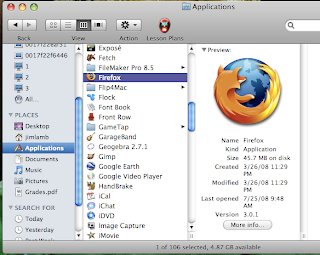
3. Right-click (or ctrl-click) on the icon and choose Copy "Application" ("Application" is replaced with whatever application you're working with, Firefox in my case).

4. In Preview (open Preview if you already haven't), choose New from Clipboard.
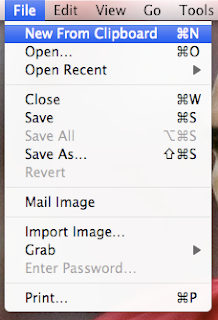
Now you have icons that you can work with! You can take these icons and drag them to iPhoto for use with any of your iWork apps. I hope this helps out anyone who was trying to figure out how to do this.
I figured, what better way to make sure I remember than to blog it! Not only will I be able to access it later on, but I can also share it with everyone else! So here is a quick tutorial on how to do it!
1. Open your Applications folder. I like to do it through the Go menu, but however you want to do it will work, as well.

2. Choose the application that you want the icon for.

3. Right-click (or ctrl-click) on the icon and choose Copy "Application" ("Application" is replaced with whatever application you're working with, Firefox in my case).

4. In Preview (open Preview if you already haven't), choose New from Clipboard.

Now you have icons that you can work with! You can take these icons and drag them to iPhoto for use with any of your iWork apps. I hope this helps out anyone who was trying to figure out how to do this.
7.07.2008
Disappointing Article
So I was browsing through recommended articles for me from Yahoo!, and I see this headline: Technology reshapes America's classrooms. Of course, I immediately open the article and begin reading, thinking about how they'll talk about Bloom's new taxonomy and 21st Century skills. I was psyched that the media was finally catching wind of what we're doing in our classrooms.
Then I read the article, and I realized that there was no substance to it! The first paragraph was heading down a good road, but then the author takes a wrong turn. This article ends up talking about how computers are being used instead of textbooks (which is a good use), and then begins talking about charter schools and online classes.
WHAT?!?
Where's all the talk of collaboration? What about getting kids to find information, analyze it, and then create new information? Where's the talk of getting kids to think? "This makes me learn better. It's like playing a game." If all this author got out of technology in the classroom is learning as if students are playing games and online classes, then this guy has totally missed his mark. I think those of us in Pennsylvania should invite Jason Szep into our schools to show him what the 21st Century classroom looks like.
Then I read the article, and I realized that there was no substance to it! The first paragraph was heading down a good road, but then the author takes a wrong turn. This article ends up talking about how computers are being used instead of textbooks (which is a good use), and then begins talking about charter schools and online classes.
WHAT?!?
Where's all the talk of collaboration? What about getting kids to find information, analyze it, and then create new information? Where's the talk of getting kids to think? "This makes me learn better. It's like playing a game." If all this author got out of technology in the classroom is learning as if students are playing games and online classes, then this guy has totally missed his mark. I think those of us in Pennsylvania should invite Jason Szep into our schools to show him what the 21st Century classroom looks like.
7.03.2008
Going Home Already?
So, here I am sitting in the airport in San Antonio. It's a bittersweet feeling, leaving a city and conference as great as NECC 2008 was. As soon as I got to the airport, I felt the need for coffee. Great, they only have Starbucks (not a Starbucks fan). Oh, wait, there's a Dunkin' Donuts here, too! Awesome. I get a French vanilla coffee and chocolate glazed donut, then notice the sign that says "Grand Opening July 8, 2008." I guess that'll be the celebration. Not sure how many people will come to the airport to celebrate, especially since they'll have to get a plane ticket!
I can't believe how many ideas I got from this conference, with the biggest ideas being for using cell phones in my classes. I cannot wait to see how this experiment will work, and I hope it will encourage others to see the possibilities this technology gives teachers. There are so many teachers that I know that are complaining they want cell phones and iPods banned. Why? Is it so bad that kids listen to music while working on a worksheet? I listen to music while I'm working all the time. And if you're worried about kids cheating by texting answers on their cells, then maybe you're not testing for the right things. No offense, but if I'm only writing a date or identifying a participle (not that I remember what they are) or writing down a memorized formula, am I really being assessed on what I know, or trivial facts I can remember?
True, there are benefits to training ourselves to remember some of these things, and it really does make many higher-order thinking problems easier to deal with. But if I need to know the date of a certain event, can't I just look it up? Shouldn't I be learning how to find the information that I need when I need it and how to analyze it to create something new or solve some problem?
Now, does this mean that we should let kids use textbooks and all resources for tests and quizzes? By all means, no. But it it something to think about when designing assessments and how you're going to deliver content.
In my district, there will be three of us teaching our Advanced Algebra courses. The original plan was to have us all collaborate to create materials to use for this year so we're all delivering roughly the same content. However, I didn't really join in on it, as I don't think I buy into it. I know I won't be teaching the class the same in April as I will be in September. And I won't be teaching it the same as I did two and three years ago. I know what I need to cover. I know what the kids need to learn. But I don't know what new methods and technologies I will be using, so it's time to try new things (again).
Over the next two months, I will be visiting the NECC page to see all of the podcasts and videos that were made available. It's like the never ending conference, and it's great! Between reading what other conference-goers have experienced and communicating with them through twitter, Plurk, email, Skype, etc., I have just enlarged my PLN to a point where the learning will not end.
I can't believe how many ideas I got from this conference, with the biggest ideas being for using cell phones in my classes. I cannot wait to see how this experiment will work, and I hope it will encourage others to see the possibilities this technology gives teachers. There are so many teachers that I know that are complaining they want cell phones and iPods banned. Why? Is it so bad that kids listen to music while working on a worksheet? I listen to music while I'm working all the time. And if you're worried about kids cheating by texting answers on their cells, then maybe you're not testing for the right things. No offense, but if I'm only writing a date or identifying a participle (not that I remember what they are) or writing down a memorized formula, am I really being assessed on what I know, or trivial facts I can remember?
True, there are benefits to training ourselves to remember some of these things, and it really does make many higher-order thinking problems easier to deal with. But if I need to know the date of a certain event, can't I just look it up? Shouldn't I be learning how to find the information that I need when I need it and how to analyze it to create something new or solve some problem?
Now, does this mean that we should let kids use textbooks and all resources for tests and quizzes? By all means, no. But it it something to think about when designing assessments and how you're going to deliver content.
In my district, there will be three of us teaching our Advanced Algebra courses. The original plan was to have us all collaborate to create materials to use for this year so we're all delivering roughly the same content. However, I didn't really join in on it, as I don't think I buy into it. I know I won't be teaching the class the same in April as I will be in September. And I won't be teaching it the same as I did two and three years ago. I know what I need to cover. I know what the kids need to learn. But I don't know what new methods and technologies I will be using, so it's time to try new things (again).
Over the next two months, I will be visiting the NECC page to see all of the podcasts and videos that were made available. It's like the never ending conference, and it's great! Between reading what other conference-goers have experienced and communicating with them through twitter, Plurk, email, Skype, etc., I have just enlarged my PLN to a point where the learning will not end.
7.02.2008
Wordle
Jeff Rothenberger shared this one with me from a session he saw. Wordle is amazingly easy to use, and pretty self-explanatory. You enter some words or choose a place to choose the words from. Then edit font, colors, arrangement of letters, etc. Then you're given options to print or embed after saving. Here's the first one I did, pulling in text from an earlier blog post:

Reflections on NECC 2008
Don't worry, the conference hasn't ended yet. There's still the closing Keynote. But I felt I needed to sit down before then and gather a few thoughts, even though they're not mind-boggling.
First, I want to go with some new things I have learned, and I'll do them in a list format.
First, I want to go with some new things I have learned, and I'll do them in a list format.
- Pennsylvania is so far ahead of many other states thanks to Classrooms for the Future. I have talked with technology integrators from other states that don't know about so many collaboration tools or Web 2.0 apps that can be useful in education. I am so glad that we have our network of coaches and mentors (with teachers joining in now, as well) to share, collaborate, educate, discover, and everything else with.
- Even though PA is ahead of the curve, I have found that there are many things that many of us still don't know and haven't seen. I saw in a session today a way to create a slider in Excel to instantly change values, which can be used in comparing graphs instantly. Now I just have to review the process and learn how to do it myself.
- Apple has taken away some of their accessibility. They did not have a display on the floor. They were only running sessions. I've heard reasons as to why they have done this, but I don't know if they're true or not, so I won't list them. However, it would have been nice to have been able to stop by and just talk with some reps from Apple. I didn't need to see any equipment in order to communicate with them. I was able to talk with so many other vendors and create some contacts. I stopped by Apangea today, and the one vendor remembered me from last year! These are the connections we need to make.
- I don't like having to sit down at a session at a booth to hear about your product. I don't need to see you play on an interactive whiteboard for 20 minutes when I would much prefer to ask the questions I want to ask about whatever it is I'm seeing and getting what I want to see. Next time, if a vendor says, "Why don't you sit down and watch our presentation? It'll only be 5 minutes," I don't know what I'll do. I much prefer the vendors who are more personal and willing to give me what I want.
- The next big thing in education will be cell phones. There are already many great tools that can be used to integrate into education, and as more and more teachers begin to integrate this technology, we will see even more robust solutions showing up. I wonder which wireless company will be the first to push their phones as educational devices? Will they create sites and content for education?
Subscribe to:
Posts (Atom)

 Posts
Posts


